Why Every Data System Is Being Rebuilt for Robots, Not Just Humans
If you sell, manage, or position data and observability products, you’ve probably noticed the same story playing out across every category: search platforms, vector databases, monitoring tools, analytics suites. Each one is scrambling to say it’s “AI-ready” or “agent-native.” This isn’t a marketing trend — it’s a real architectural shift, and understanding it will help you explain to customers why it matters and where the real value (and the real gaps) still are.
The old pattern: split first, unify later
Nobody sat down and designed “three separate systems for logs, metrics, and traces” or “three separate systems for databases, search, and AI similarity matching.” Each category solved one urgent problem at the time, using the best technology available:
- Relational databases answer “what is true right now?” (a customer’s account balance, an order status)
- Search engines (like Elasticsearch) answer “which documents mention this?”
- Vector/AI similarity databases answer “what is conceptually similar to this?” (used heavily in AI chatbots and recommendation engines)
These stayed separate for a good technical reason: a system built to be great at one of these jobs is usually bad at the others. That’s why the market split into distinct vendor categories — Postgres and its ecosystem for transactions, Elastic for search, Pinecone/Weaviate for AI similarity matching. Each built a real business on owning their slice. The same split happened in monitoring/observability, where metrics, logs, and traces became three separate product categories, three separate line items, and often three separate buyers inside the same customer account.
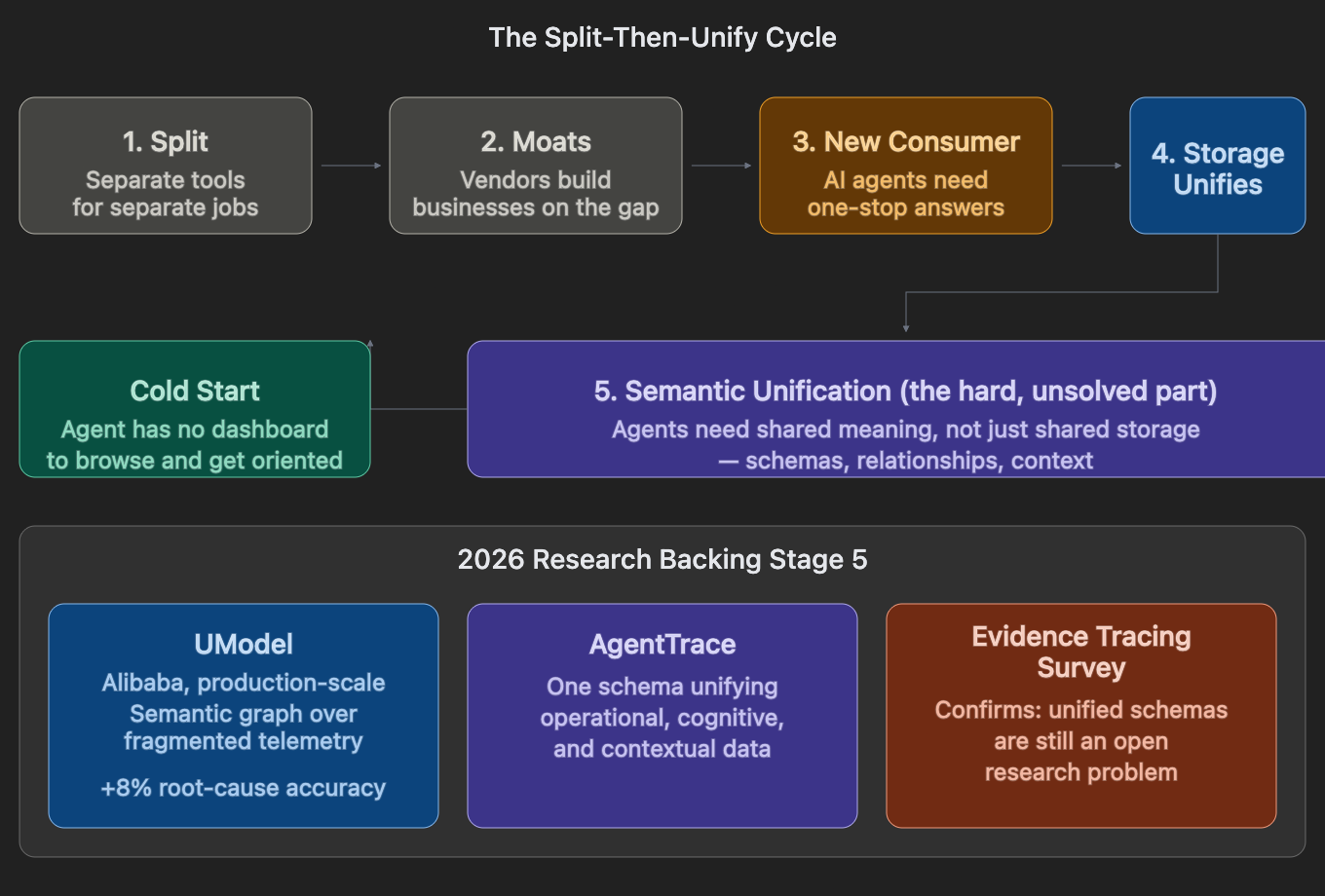
Here’s the pattern end-to-end, and where things stand today:
What changed: a new kind of “user” showed up
Starting around 2023, a new consumer of data appeared that doesn’t behave like a human: the AI agent. An agent doing a task — debugging an outage, answering a customer question, researching a market — doesn’t want to log into three different dashboards and manually stitch the answer together. It wants one place to ask a question and get a complete answer. This is forcing vendors across categories to unify what used to be separate: Postgres bolted on AI-similarity search, Elasticsearch did the same, and observability platforms merged metrics/logs/traces into single stores.
The research is catching up — and it validates the “agents need something different” thesis
A few notable 2026 research papers back this up in ways that are useful in front of a technical buyer:
- UModel (Alibaba, June 2026) — Alibaba’s cloud infrastructure team published a paper describing exactly this problem in their own systems: fragmented data, incompatible formats, and missing context were preventing their AI agents from reliably diagnosing outages. Their fix — organizing all operational data into one connected, machine-readable model — has been running in production for over a year and improved root-cause-detection accuracy by 8%. Real, deployed, production scale — not a lab experiment.
- AgentTrace (Feb 2026) — A framework unifying everything an AI agent does (decisions, execution, external interactions) into one consistent record. Useful shorthand for explaining why “all your data in one database” isn’t the same as “usable by an AI agent.”
- Evidence Tracing and Execution Provenance survey (June 2026) — A broad academic survey confirming the industry still hasn’t agreed on standard ways to structure this data. This is a genuinely open problem, not something any single vendor has already solved.
Why “just give the agent a database connection” doesn’t work
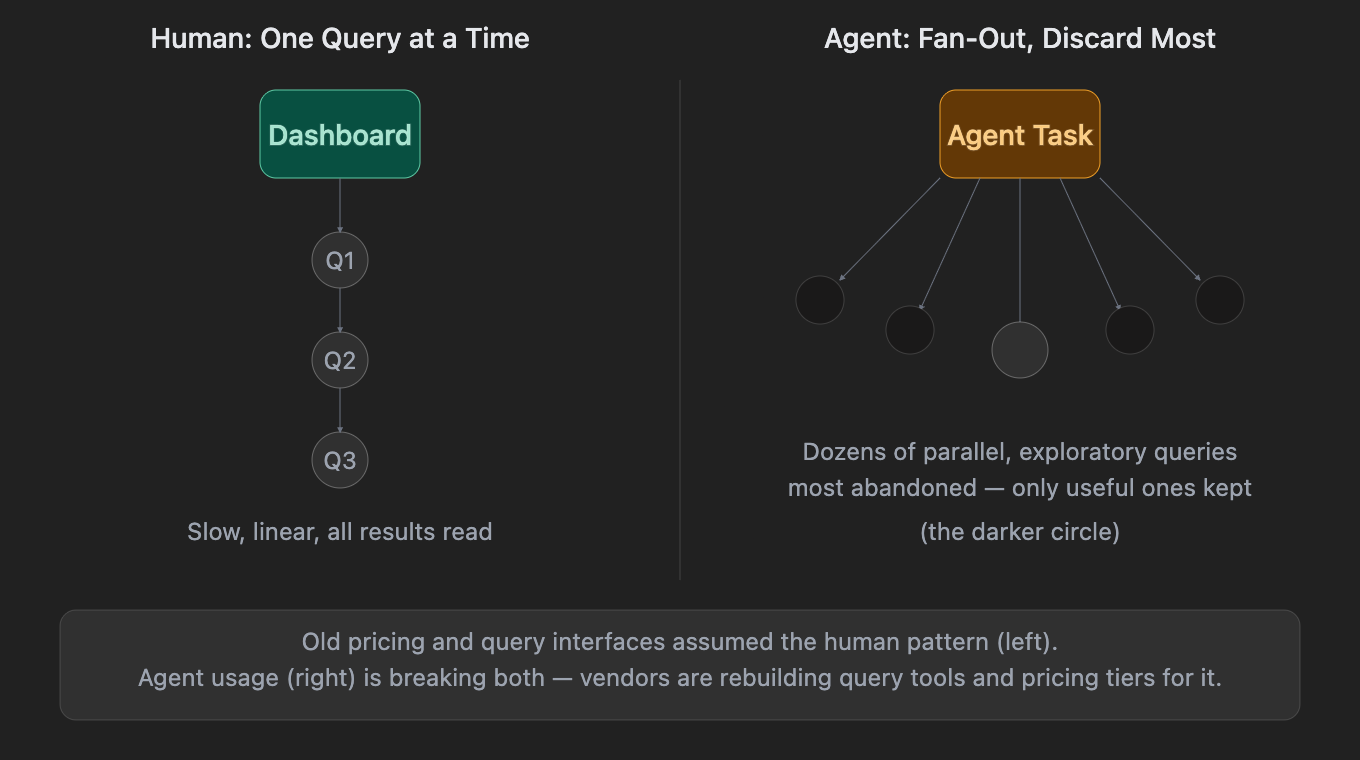
Giving an AI agent raw query access (plain SQL, say) to a database is not the same as making that data usable. Multiple independent teams — Alibaba’s UModel team and infrastructure vendors alike — found the same thing: agents perform noticeably better with purpose-built, pre-structured ways to ask questions, rather than a generic query language they have to figure out the schema for on the fly. The difference shows up as fewer wasted steps, fewer errors, faster answers — and it also shows up structurally in how an agent queries a system versus a human:
Sales/PM takeaway: if a competitor’s pitch is “we support AI agents because we have an API,” that’s a weaker claim than “we’ve built agent-specific tools that understand our own data model.” The difference materially affects real-world agent performance, and now there’s published research to point to.
The next problem: agents don’t know where to look
Even after data is unified and well-structured, there’s a subtler problem: a human opens a dashboard and browses around to get oriented. An AI agent connecting to a system for the first time has no equivalent — no eyes, no intuition about what’s reliable, what’s stale, or where to start (see “Cold Start” in the first diagram). Solving this — giving an agent a way to understand a new system on its own — is an active, unsolved area of investment across search, databases, and analytics generally, not just observability. This is a good talking point when customers ask “why isn’t this already solved everywhere?” — because it genuinely isn’t, and that’s where near-term product differentiation will happen.
Cost models are also being rewritten
Worth flagging for pricing conversations: as the diagram above shows, agents don’t query data the way humans do — a single investigation can fire off fifty exploratory queries and discard forty-five. That breaks a lot of existing usage-based pricing models built around human-paced behavior. Several vendors across observability and AI-database categories have already introduced new pricing tiers to handle this. If customers are ramping up agent usage, expect this to come up.
One important caveat
Not every category of data unifies as cleanly as observability did. Metrics, logs, and traces are three views of the same underlying system (your infrastructure), so unifying them is a genuinely coherent goal. Structured records, search text, and AI-similarity data are often about fundamentally different things — a customer record, a support ticket, and a document aren’t three views of one fact. Full unification is a harder, and possibly less complete, goal outside of observability — useful to know so you don’t overpromise “total unification” to a customer in a category where it may not fully apply.
The bottom line for positioning conversations
The pattern to watch, across every data category: tools split apart to solve narrow problems → vendors build businesses around the split → AI agents arrive needing something the old interfaces can’t give them → storage unifies first (relatively easy) → true semantic unification and “agent onboarding” unify last, and that’s where the real competitive battle is still being fought in 2026. Observability is a few years ahead of other categories in this cycle, which makes it a useful preview of what’s coming next in search, databases, and analytics.